
Finding Where the Signs End in Akihabara: How Signage Changes from Electric Town to Red-Brick Tokyo Station and Ginza
Finding Where the Signs End in Akihabara: How Signage Changes from Electric Town to Red-Brick Tokyo Station and Ginza
You've been to Akihabara a few times now. You step out of the station, look up at the signs along Chuo-dori, head into Radio Kaikan, and buy a charging cable at Yodobashi Camera. By now your feet probably do all that on autopilot, right?
This time, let's look at things a little differently. Instead of the signs themselves, we'll look for the places where the signs stop. In a neighborhood packed with bright vertical lettering, where does it give way to glass? Where does it turn into red brick? And where does it settle into calm stone streetscapes? Tokyo looks like a different city when you watch the boundaries.
On Your Second Visit to Akihabara, Start by "Reading" the Signs
If you're from Taiwan, you might think of the signs around Taipei's Guanghua Digital Plaza or Ximending. In Chinese, a shop sign is called a "招牌" (zhāopái). In Taiwan, many signs seem to stick out sideways over the street. Akihabara is different. Here the signs climb straight up the building walls, top to bottom, with each floor's shop name stacked on the next like steps on a staircase.
The first time you came, your reaction was probably just "That's way too much information!"
On your second visit, try actually reading them. Kanji, katakana, English letters, and anime characters all share the same wall. Because the floor directory doubles as the signage, you can get a rough idea of what's inside a building just by standing outside it.
Many Japanese kanji look a lot like traditional Chinese characters. If you're from Taiwan or Hong Kong, you can skip the katakana and pick out only the kanji. That alone shows you more about the shops than you'd expect. "電器" (electronics), "中古" (secondhand), "買取" (we buy). Catching those is plenty.
And there's a spot where those vertical signs suddenly disappear. Stand in front of Akihabara UDX and you'll see it clearly. A huge glass surface reflects the light, and the flood of lettering you just walked through suddenly goes quiet. You're still in Electric Town, but once the wall material changes, the street seems to slow down a notch.
Honestly, once you notice this contrast, even the way you take photos changes. Look for shots where a wall of signs and a wall of glass meet in the same frame.
Where Does the City of Letters Turn into Red Brick?
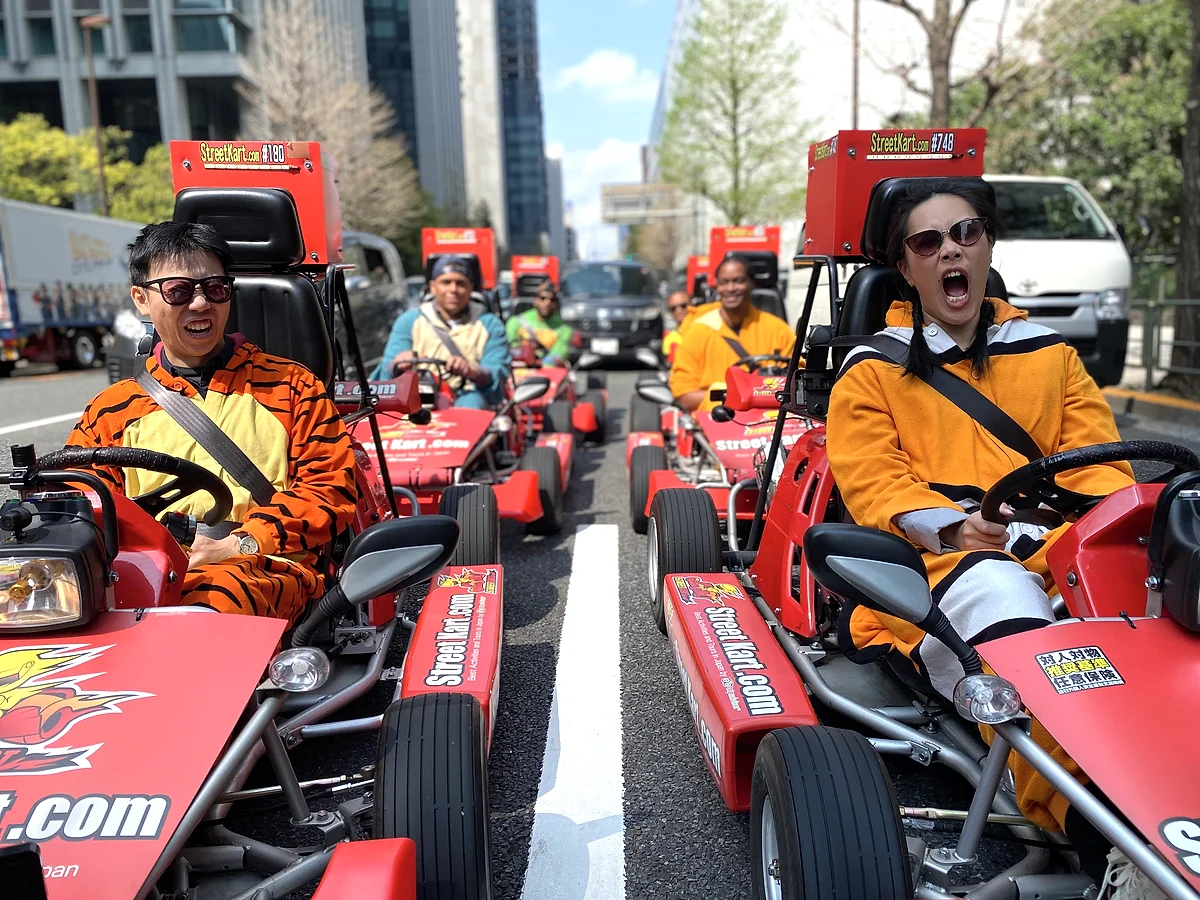
On tours from Street Kart's Akihabara 1st and 2nd shops, the sights along the route include Tokyo Station's Marunouchi Station Building and the streets of Ginza, as well as Akihabara Electric Town. Kanda Myojin and Ochanomizu are also in the area around the route. The roads you take depend on the course, so check the official website for details.
What's interesting here is how the "materials" of the scenery swap out one after another.
Electric Town is built from letters and light. Most of the walls are signs, and the colors hit you before the shapes of the buildings do.
Once you reach the Marunouchi Station Building of Tokyo Station, the buildings suddenly take center stage. The red-brick station building opened in 1914 (Taisho 3), and restoration work was completed in 2012. Its style is Tatsuno-style free classic. White stone bands run horizontally across the red brick, and the building, with domes at both ends, stretches on and on.
Eyes that were reading signs start following the lines between bricks. That moment of switching is surprisingly moving.
Ginza brings yet another material. The Wako clock tower at the Ginza 4-chome intersection, Ginza Mitsukoshi, Matsuya Ginza, and a little farther away, the Kabukiza theater. They're all big stores, but they handle signage in a completely different way. No covering whole walls with lettering like in Akihabara. Logos stay small, and the building's own facade does the talking. In Chinese, you might call it "低調奢華" (understated luxury).
So along this route, Tokyo's signage culture shifts bit by bit through the scenery, from crowded signs to restrained ones. The guide leading the tour decides which roads you take and in what order, so I can't promise a sequence here. Still, the city of letters, the city of brick, and the city of stone all show up in the scenery of a single tour. On your last trip, walking around only Akihabara or only Ginza, those views never connected.
When the Light Changes, the Same Signs Make a Different City
A city of signs changes its face with the light.
In daylight, Akihabara's signs show their true colors. Red, yellow, light blue. The combinations are pretty bold, and in the sunshine they look like pop art.
When the sun gets low and the signs light up, things change. The edges of the letters become lines of light, and the shapes of the buildings fade into darkness. The stretch of time when the sky gets darker and the signs get brighter is, honestly, something I could watch forever.
The red-brick station building works the other way. The softer the light, the deeper the color of the brick. Under strong sun it leans toward bright orange; on a cloudy day it shifts toward a calm reddish brown. Neither one is the "right" look. The point is that the sky on the day you go will give you a completely different photo.
One important note. Sunset times, heat, and how cold the wind feels all change a lot with the seasons. Tokyo summers are very hot, and in late autumn and winter the sun sets early. That's why this article won't say "go at this time and you'll see this." The most honest approach is to take whatever sky you get at your booked time as that day's scenery. A bright Akihabara with the signs unlit and an evening Tokyo Station with the brick sinking into shadow each have their own appeal.
What Makes Street Kart Appealing
I've talked mostly about scenery, so here's a rundown of the vehicles and the tour.
First, it's a guided tour. At Street Kart, a trained guide drives at the front. Participants follow the guide along a set route. You don't need to memorize roads or look at a map. There are also stops along the way for taking photos.
Second, the view from a kart. Once you're in one, the building walls you usually look up at seem much taller. Akihabara's stacked vertical signs loom over you more like cliffs than walls. You feel the wind on your face. The sounds of crossing signals and the cars around you come straight to your ears. You feel very close to the city itself.
Third, the range of scenery on the route. As mentioned above, routes from the Akihabara shops include sights such as Electric Town, Tokyo Station's Marunouchi Station Building, and Ginza. From the city of signs to red brick, and then to the calm facades of Ginza. You can see Tokyo's different materials in one continuous ride. That's what makes this route special (the roads you take depend on the course).
Fourth, the language of the guidance. On the day of the tour, guidance is basically in English. Guidance in Japanese or other languages depends on the staff that day, so it can't be promised. If this matters to you, contact them before booking. The official website, by the way, is available in 22 languages.
Fifth, there are two shops in Akihabara. The Akihabara 1st and 2nd shops are at nearly the same location.
Sixth, the track record. As of November 2023, across all shops, there had been more than 150,000 tours, more than 1.34 million customers, more than 20,000 reviews, an average rating of 4.9 out of 5, and more than 250 vehicles. All of these figures are as of November 2023, not current values. Still, I think knowing how many times these tours have run is a useful reference point.
Seventh, the number of shops. Street Kart has nine shops nationwide: seven in Tokyo, one in Osaka, and one in Okinawa. The seven in Tokyo include pairs at nearly the same location, such as the Akihabara 1st and 2nd shops, and Shibuya and Shibuya Annex. So it doesn't mean you can ride from seven separate places in Tokyo. If you like Akihabara's city of signs, you could pick a route from a different shop on your next trip.
Boundary Spots to Walk Around Akihabara Before or After the Tour
Once the kart has given you a feel for how the scenery flows, I recommend walking to the boundaries that caught your eye, either before or after the tour. The places below are stops around the shops. They are not part of the tour course.
Compare "Sign Density" Within Electric Town
The area around the shops is Akihabara Electric Town itself. Radio Kaikan, Sofmap, Animate Akihabara, Yodobashi Camera Akihabara. You probably went into many of these on your last trip. This time, before going in, try photographing the whole building from outside.
The trick is not to shoot the wall of signs head-on. Stand at the edge of the street and capture the row of buildings at an angle. The signs layer back into the distance, and the packed feeling really comes through. Leaving a little sky or a building with fewer signs at the edge of the frame actually makes the density stand out more. A vertical crop brings out the impact of the stacked signs. When editing, don't push the saturation too far. The primary colors of the signs are already strong enough.
Secondhand hobby shops like Mandarake, Surugaya, and Super Potato are also in this area. Compare the feel of their lettering with the signs on newer buildings. New and old signs side by side on the same street are another part of how Akihabara's scenery keeps changing.
Feel the Signs Disappear at Kanda Myojin
About a 10-minute walk from the shops brings you to Kanda Myojin. Known as the guardian shrine of all Edo, it has 1,300 years of history. People come for prosperity in business and for matchmaking. The Kanda Matsuri festival takes place in May. Some visitors also come because it appears as a setting in anime.
What's interesting here is that as you walk from Electric Town, the lettering on signs gradually thins out. In the end, you're left with nothing but a vermilion gate and the color of wood. From a city of letters to a place with no letters. You can check the "change in materials" you saw from the kart, this time at walking speed. Taiwanese temples are heavily decorated and rich in color, but Japanese shrines use a much more pared-back design. If you're from Taiwan, the difference may surprise you a little.
Many people will want to capture the red-brick station building they saw on the tour with their own camera. But using your smartphone while driving is dangerous, so keep your hands on the wheel. If you walk there after the tour, you can take photos at your leisure. Tokyo Station is about a 20-minute walk from the shop area, or about 5 minutes by train.
The classic shot is the front, on the Marunouchi side. The station building is very wide, so to fit it all in, use a wide angle and step back a bit. Alternatively, zoom in and crop just the brick wall and white stone bands. Put that next to your Akihabara sign photos, and the difference in materials really stands out. Make the first image Akihabara's signs and the second Tokyo Station's brick. That alone tells the story of "from a city of letters to a city of buildings" at a glance. For hashtags, it's a nice idea to add the Chinese #秋叶原 #东京站 #東京車站 to the Japanese #秋葉原 #東京駅.
Ginza is about 10 minutes by train from the shop area. Depending on the course, it's fun to revisit on foot the Wako clock tower and Ginza Chuo-dori that you passed on the tour. Going to Ginza after a long look at Akihabara's signs makes the small logos, the way the shop windows are displayed, and the approach of using fewer words to create a sense of luxury very clear. You'll find yourself thinking, "Two parts of the same city can think about signs this differently?"
For a meal, the long-established soba restaurant Kanda Yabusoba is about a 15-minute walk from the shop area. Walk a short way from the electronics district and you're stepping under a soba shop's noren curtain. That contrast is part of the shifting scenery too. Tonkatsu Marugo is about a 10-minute walk, and Akihabara Ramen Street is about 5 minutes on foot.
A word on photo etiquette. The sidewalks in Electric Town are crowded. Setting up a tripod or standing in the middle of the sidewalk to keep shooting gets in people's way. Step to the side when you shoot and keep it quick. That's the basic rule. Rules on photographing inside shops or photographing staff vary by shop. If you want a photo, ask first. At the shrine, too, try not to photograph people praying in front of the hall from directly in front. Don't worry if you're not confident with the language. Showing "May I take a photo?" on a translation app gets the message across.
Things to Check Before Booking
To join the tour, you need to meet driver's license requirements. You must be 18 or older and hold a valid license to drive a four-wheeled vehicle. Only the original physical license is accepted; digital licenses can't be used. The documents you need depend on which country's license you have and what type it is, so check the official website for details. If you don't have the required documents on the day, you can't take part and won't get a refund, so check carefully before you set out.
Bookings are accepted through Facebook, LINE, and email. Contact details are on the official website. Weekends tend to fill up, so if you want to ride on a weekend, book early. Prices vary by season and time slot, so they aren't listed in this article. Please check the official website (kart.st) for details.
For finer details, such as how groups are split up, please check the official website.
Take the train to the shop. The shops have no parking. Nearby stations are Akihabara Station (JR, Tokyo Metro Hibiya Line, and Tsukuba Express), Suehirocho Station on the Tokyo Metro Ginza Line, and Iwamotocho Station on the Toei Shinjuku Line.
Next Time in Tokyo, Go Looking for the Boundaries
Read Akihabara's signs one by one. Then follow the way they turn into glass, into red brick, and into the stone buildings of Ginza. I especially want people who've already been to Akihabara to try seeing it this way.
Once your dates are set, start by opening the Akihabara shop page on the official website and checking the license requirements and booking contacts. If you want to ride on a weekend, book as early as you can.
Afterward, walk the city of signs you saw on the tour again on your own two feet. The same signs should look a little different. The boundaries are usually right under your feet.
This article was originally written in Japanese and translated using AI. Some expressions may read unnaturally, and we appreciate your understanding. For the most accurate and up-to-date information, please refer to the official site at kart.st.
Street Kart is not affiliated with Nintendo or the Mario Kart series in any way. We do not provide costumes of Nintendo characters, and such costumes may not be worn during tours even if brought by participants.