
Make Your Tokyo Farewell or Welcome Party a Street Kart Ride: 7 Mistakes Organizers Make and How to Avoid Them
Make Your Tokyo Farewell or Welcome Party a Street Kart Ride: 7 Mistakes Organizers Make and How to Avoid Them
"Another round of drinks at an izakaya, and that's it?"
Maybe it's a night when your friends in Tokyo welcome you back after a long time away. Or a weekend when you send off someone you spent your Tokyo days with. Why not add one thing to that gathering: time when everyone gets behind the wheel together, before the first toast.
There's a catch, though. Plan it the way you'd plan a drinking party, and on the day you may hear: "Wait, I'm the only one who can't drive?"
So this article goes in reverse order. The fun part comes later. First, the places where organizers trip up.
Why farewell and welcome parties work better with "one more plan"
In Japan, the work year starts in April. That makes March the season for farewell parties and April the season for welcome parties, so gatherings pile up. Chinese has its own words for this: 歡送會 (huānsònghuì), a send-off party, and 接風洗塵 (jiēfēng xǐchén), the custom of hosting someone who has come from far away. The feeling behind them is almost the same.
Where things differ may be the choice of venue. In Taiwan, you'd gather around big plates at a rèchǎo stir-fry restaurant while the beer bottles on the table keep multiplying. In Japan, it's a set course at an izakaya: the organizer gives a toast, and the night closes with a ceremonial clap called ippon-jime. I love both! But if you've been to Tokyo a few times, let's be honest: you already know how this goes.
So try fitting one experience in before dinner.
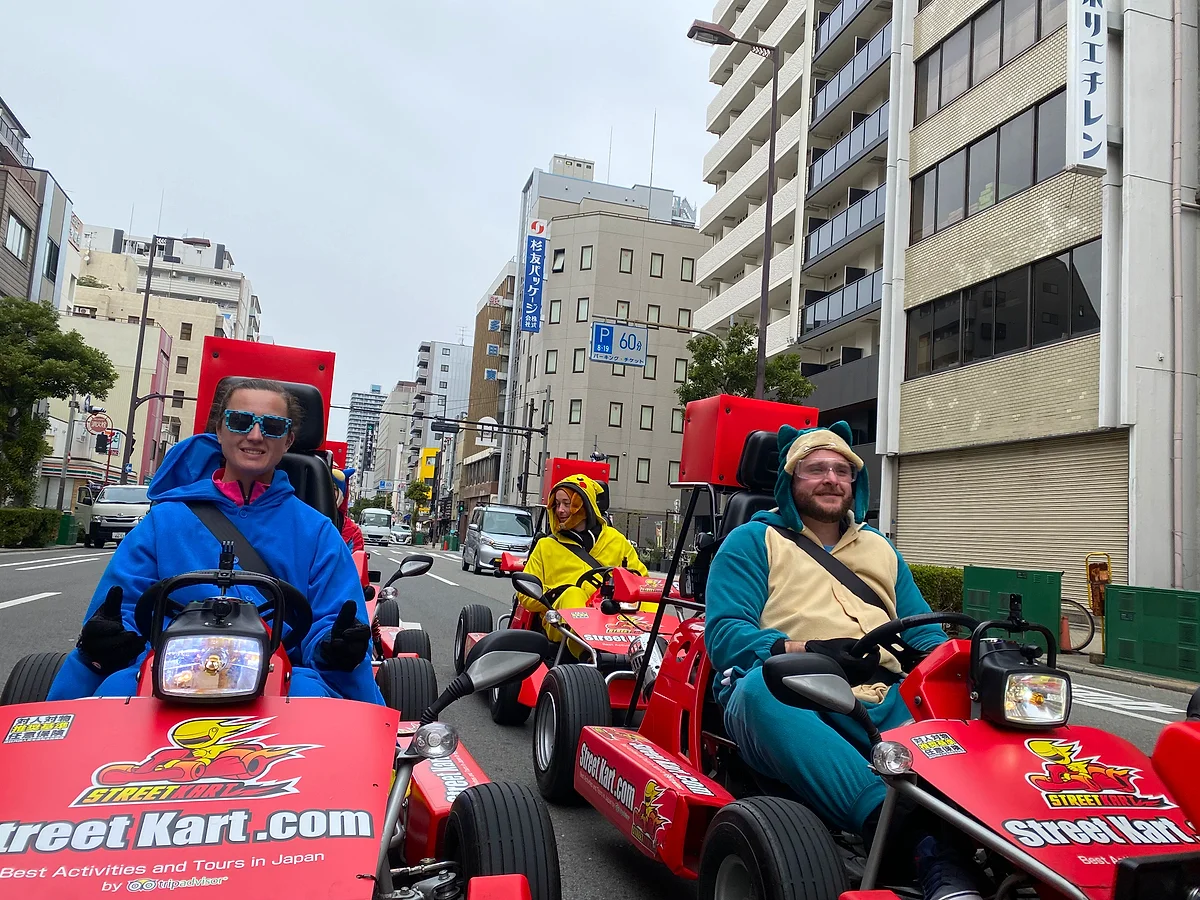
Street Kart is a tour where you drive through the streets of Tokyo behind a guide. Everyone sees the same scenery from the same eye level. Then, once you've finished the ride and sat down, someone says "That intersection, though..." and the conversation takes off on its own. For the person being sent off, it becomes one of the last sights they see before leaving Tokyo. For the person being welcomed, it becomes a memory made right after the reunion. That first drink will taste a little different from the usual "good work today."
That said, karting isn't a drinking party. You can't just show up and join in. This is where the real advice begins.
7 mistakes organizers make and how to avoid them
Mistake 1: Assuming everyone can drive
This is the first thing to check.
Karts are single-seaters. Nobody can ride behind someone else, and two people can't share one kart with the better driver at the wheel. That means every single participant has to meet the requirements to drive on their own.
The license requirements depend on whether you hold a Japanese license, a foreign license, or an International Driving Permit. A short summary here would only cause confusion, so have every member read the official guide on driver's licenses themselves. Please check the official website for details.
The fix is simple. Before you even pick a date, post the link to the official guide in your group chat and ask everyone to "check whether you qualify." That's all.
The scariest thing on the day is "I'm probably fine."
If someone doesn't meet the requirements, have them join you at the after-party venue. If you plan it that way from the start, nobody feels awkward.
Mistake 2: Making it a surprise for the guest of honor
A classic farewell-party move: you want to surprise the guest of honor, so you keep the destination secret until the day itself. I totally get it!
But with karting, this can easily backfire, for the same reason as Mistake 1: license requirements. If the guest of honor doesn't bring what they need, you end up with a farewell party where the guest of honor is the only one who can't ride. That's not touching. It's just sad.
My recommendation is the "keep the plan secret, share the packing list" approach. Just say: "On [date], bring the items listed in the official guide (like your original driver's license). Why? You'll see on the day." The surprise stays intact.
Another option is to move the big surprise to after the ride. Messages written on a card at the after-party, or a video message. Those you can hide as long as you like.
Mistake 3: Toasting first
Gatherings in Japan often kick off with "let's start with a toast." On kart day, flip that order.
Driving a vehicle after drinking alcohol is prohibited by Japanese law. That includes "just one drink" or "just a little." Ordering a beer at lunch and driving in the afternoon is also out.
The only option is "drive, then toast."
This actually makes things easier for the organizer. Just book the restaurant for after the ride in advance, and that first drink becomes a proper reward. If you're doing it over two days, with the first party the night before and karting the next day, it's a good idea to add a note to everyone: "Don't drink so much that it's still in your system the next day."
Mistake 4: Trying to book a weekend at the last minute
Everyone wants to hold the gathering on a Saturday or Sunday. And weekends tend to book up fast.
In March and April, when farewell and welcome parties overlap, it's hard enough to find a weekend when everyone is free. If you finally land on a date and can't get a reservation, you're back to square one with scheduling.
There are two ways to avoid this.
One is to book early, as soon as you have candidate dates. The other is to include weekdays as options if many members can take time off easily.
Reservations are accepted via Facebook, LINE, and email. You can find the contact details on the official website. For large groups, confirm during the booking process whether everyone can ride together.
Mistake 5: Assuming your group will have the tour to itself
It's easy to assume that if you book for 10 people, it'll be a tour for just those 10. Don't take that for granted. Please check with the official booking contact whether your group can ride on its own.
If you don't confirm this, you might end up starting a speech for the guest of honor in front of the shop before departure, while other people wait on you.
So save the farewell speech and the toast for the after-party. Think of the kart time as "time to see the same views together." With that mindset, you won't be thrown off no matter how things turn out on the day.
Mistake 6: Not checking the guidance language
On tour day, guidance is generally in English. Whether guidance is available in Japanese or other languages depends on the staff that day. It isn't guaranteed.
That may be fine for you if you read English, but mixed groups with people from different countries are where things get tricky. A Japanese coworker who isn't confident in English. A friend who's more comfortable in Chinese. Members like that may well be in your group.
You can prepare for this by sharing information in advance. Hearing safety instructions in English for the first time on the day is stressful. Reading the official website in your own language beforehand lets you arrive much calmer.
The official website is available in 22 languages. You can send the Chinese page to friends who prefer Chinese and the Japanese page to Japanese coworkers. If anyone is worried, it's reassuring to consult the official contact at the booking stage.
One more personal tip: pick someone in the group who's strong in English as the "interpreter." Have them stand next to anyone who's nervous during the pre-departure briefing. That alone eases the mood a lot.
Mistake 7: Meeting up by car, or picking a far-off after-party venue
A common organizer mistake is choosing based only on the shop's location.
Start with transportation. The shops have no parking, so meet up by train. Just remember that coming by public transport is the default.
Next, the after-party. You want to toast while everyone's still buzzing from the ride. If getting there takes too long, that energy fades. The trick is to choose the shop by working backward from the after-party location. I'll lay out specific pairings a little further on.
Why groups choose Street Kart, through an organizer's eyes
The fun part lands better once you've covered the pitfalls. Here are the points that matter when you look at it as the organizer of a gathering.
First, a guide leads the way. Each shop has its own course, and a guide drives in front. Please check the official website for route details.
Second, the guides leading the tours are trained for foreign drivers. Whether it's a guest of honor visiting from abroad or a foreign coworker living in Japan, everyone follows the same guide.
Third, there's the feel of the kart itself. This is just my own impression, but sitting in a kart makes a Tokyo you've seen many times look completely different. The angle of your neck as you look up at the buildings. The hum of the city you hear while waiting at a light. The wind on your cheeks. It's a kind of time you can't share in a private izakaya room.
Fourth, the area you start from changes how you see Tokyo. There are 7 shops in Tokyo (the two Akihabara shops are in almost the same spot, as are the two Shibuya shops). Will you see the bridges of the bay area, or historic station buildings and lively downtown streets? That choice changes the feel of the gathering, too. Picking the neighborhood where the guest of honor spent a lot of time in Tokyo is a lovely touch.
Fifth, there's a track record that makes it easy to explain to first-timers. As of November 2023, across all shops combined, there have been over 150,000 tours, more than 1.34 million customers, and over 20,000 reviews, with an average rating of 4.9/5.0. Even for the cautious member who asks, "What is that? Is it safe?", you can back it up with numbers.
Sixth, language preparation is easy. As mentioned in Mistake 6, the official website is available in 22 languages, so each member can open it in whatever language they read most comfortably.
Choosing a Tokyo shop by working backward from the after-party
Here are pairings for each shop: what you'll see, and where you'll toast afterward.
One thing first. The restaurants and spots introduced here are near each shop. They aren't part of the tour course. Read them as places to head after the ride. Please check the official website for tour route details.
Shibuya: For a lively send-off
Tours from the Shibuya shop and Shibuya Annex take you through the Scramble Crossing, Harajuku's Takeshita Street, and zelkova-lined Omotesando. Streets packed with quintessential Tokyo.
Seeing an intersection you've walked across countless times from a kart instead of the sidewalk: I think returning visitors in particular will love that contrast.
For the after-party, there's Shibuya Niku Yokocho, about a 10-minute walk from the shop, and Dogenzaka Ramen Yokocho, about an 8-minute walk. Toast surrounded by grilled-meat smoke and the sizzle of iron griddles, and it should feel as lively as a Taiwanese rèchǎo place. The nearest station is Shinsen (about a 5-minute walk), and Shibuya Station is about a 10-minute walk.
Shinagawa: To celebrate a new beginning
Tours from the Shinagawa shop offer views like the Rainbow Bridge, the symbol of the bay area, Tokyo Tower in the distance, and the Takanawa area, home to Sengakuji Temple.
If you're sending off a friend who's changing jobs or moving somewhere new, make one detour before the ride: Shinagawa Shrine, about a 5-minute walk from the shop. It's known for blessings of business prosperity, so pressing your hands together to wish them "success over there" becomes a small farewell ritual.
For the after-party, head to Tennozu Isle, about a 20-minute walk away. It's an area lined with cafés and restaurants along the canal, well suited to a farewell where you want to talk quietly. If you prefer a local vibe, browsing the Kita-Shinagawa shopping street for a place is fun too. The nearest station is Keikyu Kita-Shinagawa (about a 3-minute walk), and Shinagawa Station is about a 10-minute walk.
Akihabara: For a distinctly Japanese send-off
Tours from the Akihabara shops take you past the red-brick Marunouchi building of Tokyo Station, the Wako clock tower at Ginza 4-chome, and the wall of signs in Electric Town. From a station building opened in 1914 to today's hub of subculture, Tokyo from different eras appears one after another.
For a farewell party, let me suggest something a bit old-school. Japan has a custom called hikkoshi soba: eating soba noodles when you move house. Wrap up the night at Kanda Yabu Soba, a long-established restaurant about a 15-minute walk from the shop. I think it's the perfect parting gift for a guest of honor leaving Tokyo.
Kanda Myojin, about a 10-minute walk away, is a shrine known for matchmaking and business prosperity. It's just the place to wish "let's meet again in Tokyo." The nearest station is Suehirocho on the Ginza Line (about a 3-minute walk from the first shop), and Akihabara Station is about a 5, 7-minute walk.
Tokyo Bay (Shinkiba): For a send-off by the sea and night views
Tours from the Tokyo Bay shop feature the 798-meter Rainbow Bridge, the 333-meter Tokyo Tower, and views of Odaiba.
At night, the Rainbow Bridge is lit up in seven colors. If you can ride with the glowing bridge as your backdrop, that's honestly an unfairly good climax for a farewell party. However, whether a tour is available at the time slot you want varies by day. Check the official website before you plan.
From the shop to Shinkiba Station is about an 8-minute walk. Take a breather at CASICA near Shinkiba Station, then hop on a train to your next venue. That way, the moving around won't feel rushed.
When should you take photos?
Everyone wonders about this. But using your phone while driving is a no. Focus on driving.
Take photos before departure and after the ride. A group shot of everyone in front of the shop will become the main photo of the farewell party.
If you're posting on Xiaohongshu (RED), a title like 「東京歡送會新玩法」 ("a new way to do a Tokyo send-off"), which makes it clear at a glance that this is a new kind of farewell party, works well. For hashtags, list the Japanese #送別会 (farewell party) and #歓迎会 (welcome party) alongside the Chinese #歡送會 and #東京旅行 (Tokyo travel). That makes it easier for both your Japanese friends and Chinese-speaking friends to find. Edit in VSCO or Lightroom. Boost the city's neon or the evening sky's colors just a little, and the warmth of that day stays in the photo.
One message to send to your group chat before booking
All the pitfalls above can mostly be prevented with a single message. As the organizer, just copy this, tweak it a bit, and send it.
On [date], we're going to ride Street Karts before the after-party! Karts are single-seaters, so everyone drives themselves. Please check the license requirements at the link below and let me know if you qualify. Also check the official guide for what to bring on the day (like your original driver's license) and don't forget it. No drinking until after the ride. Guidance is generally in English, so if you're unsure, please read the official website in your own language beforehand. Please come by train.
Send this. Wait until everyone has replied. Then book.
Just sticking to that order will greatly cut down on "Wait, nobody told me!" moments on the day.
Whether it's a farewell or a welcome party, what the guest of honor remembers later is often not the menu, but "what we all saw together that day."
The red-brick station in Akihabara? The glowing bridge over the bay? The crossing in Shibuya?
Once you've decided which view to send off or welcome your guest of honor with, check the courses and requirements on the Street Kart official website. Weekends tend to book up fast, so get in touch early via Facebook, LINE, or email as soon as your date is set.
Now then: the toast comes after the finish line.
This article was originally written in Japanese and translated using AI. Some expressions may read unnaturally, and we appreciate your understanding. For the most accurate and up-to-date information, please refer to the official site at kart.st.
Street Kart is not affiliated with Nintendo or the Mario Kart series in any way. We do not provide costumes of Nintendo characters, and such costumes may not be worn during tours even if brought by participants.