
Street Karting on Your Second Trip to Tokyo: Plan Around the Tour by "Changes in Scenery"
Street Karting on Your Second Trip to Tokyo: Plan Around the Tour by "Changes in Scenery"
The last time you were in Tokyo, did your carefully planned schedule fall apart at some point? You miss one train connection, and everything after it slides back. It's quietly exhausting, isn't it?
On your second trip, set the clock aside for a bit. Instead, divide your day at the points where the scenery in front of you changes. The crowds at the station. The inside of the shop. The city while you're driving. The city after the tour ends. A street kart day breaks down roughly into these four scenes. Once you know where the scenery shifts, it's much easier to plan what comes before and after the tour, one scene at a time.
Divide the Day by Scene Changes, Not by the Clock
To be honest, there isn't much of a street kart day that you can rearrange yourself. The route is set by the shop and the course, and the tour is led by a guide. While you're driving, you leave the flow to the guide.
So the part where your planning really matters is before and after the drive: getting from the station to the shop, the prep time inside the shop, and moving on to your next plan after the tour ends. Plan these three loosely, and the time around your drive turns into a scramble.
When you divide your day by the clock, you end up with a string of points: "do this at this time." When you divide it by scenery, you can think with a bit more breathing room: "while I'm in this scene, I'll do just this much." Take a breath whenever the scenery changes. I think that's just the right amount of slack for a second trip to Tokyo.
First, take the meeting time and tour details in your booking at face value. When to meet, how long you'll drive: I can't give definite answers here, because they vary by shop and course. Check the Street Kart official website and the information you receive when booking for details. From here on, we'll talk about how to plan the time before and after that slot, scene by scene.
Scene One: From the Station Exit to the Shop Door
The first break comes as you step through the ticket gates. Don't plan the walk from there to the shop door based only on your map app's travel time.
Street Kart has seven shops in Tokyo. But they aren't spread across seven different areas. Akihabara No.1 and No.2 are practically in the same place, and so are Shibuya and Shibuya Annex.
The Shibuya shops are in Maruyamacho, about a 10-minute walk from Shibuya Station, or about 5 minutes from Shinsen Station on the Keio Inokashira Line. Do you push through the famous crowds at Scramble Crossing, or come in from the Shinsen side? Even within Shibuya, what you see is completely different. On your first visit, you'll probably want to walk past Hachiko, but on your second, coming in from Shinsen is a nice option. It makes it easier to settle in before meeting up.
The Shinagawa shop is in Kita-Shinagawa, about a 3-minute walk from Keikyu's Kitashinagawa Station, or around 10 minutes from Shinagawa Station. The old-fashioned Kita-Shinagawa shopping street is nearby. If you want to enjoy the way the atmosphere changes as you walk from the station, give yourself extra time.
The Tokyo Bay shop is about an 8-minute walk from Shin-Kiba Station, in a waterfront area full of warehouses. In Akihabara, No.1 is about 5 minutes and No.2 about 7 minutes on foot from Akihabara Station, or about 3 minutes from Suehirocho Station on the Ginza Line. Once the signs of Electric Town catch your eye, you'll find yourself stopping. Get pulled into a shop window, and there's no way a 5-minute walk stays 5 minutes. The more you love Akihabara, the more time you should allow here.
Although the two Akihabara shops are "practically in the same place," No.1 has a Sotokanda address and No.2 an Asakusabashi address. The walking times from Akihabara Station are slightly different, too: about 5 minutes for No.1 and about 7 minutes for No.2. Before you head out, double-check which shop you booked. Shibuya and Shibuya Annex also have different street numbers within Maruyamacho. A few minutes lost hesitating between doors with similar names add up when they're the few minutes before your meeting time.
One important thing: the shops have no parking. Please come by train or other public transportation, not by car. In Tokyo, getting to the meeting point means trains and walking.
Watch out for luggage, too. Step through the gates dragging a suitcase, and the walk from the station to the shop gets a lot heavier. If you're driving on your checkout day, drop your bags at your hotel or a station coin locker first and head over unburdened. Adding that one extra break to your plan gives you peace of mind. Check the official website ahead of time for how large luggage can be handled.
Scene Two: Inside the Shop, When You Can't See the City
Open the door, and the city disappears for a while. This is the scene people misjudge most easily.
Inside the shop, there are procedures and briefings before you set off. How long they take depends on the shop and the day, so I won't give a number here. I can say just one thing: don't assume it'll be short just because you can't see outside. It may feel like it's over in a flash, but if you cut this time from your estimate, the squeeze usually lands on your plans after the tour.
As for driver's licenses, listing only some of the requirements would invite misunderstanding. Check the full picture on the official driver's license page. If anything about your passport or license has changed since your last trip, take another look before you leave.
Decide on your outfit before leaving your hotel. Wear closed-toe shoes (sneakers recommended). Heels, open-toe shoes, and skirts or dresses are listed as things to avoid. If you realize at the shop that your shoes aren't good for driving, you'll have to go back for others or run out to buy some. Either way, you're back to Scene One.
If you want to drive in costume, you choose from the shop's own original costumes. Of course, you can also join in your regular clothes. If you do change, include that time in this can't-see-outside scene as well.
On the day, instructions are basically given in English. Guidance in Japanese or other languages depends on the staff that day, so it can't be guaranteed. If you're worried about English explanations, contact them through the official website in advance. The website is available in 22 languages.
One small tip for this scene: take your phone photos before you go into the shop. A pre-meetup shot in natural daylight makes a perfect opening clip when you edit your videos together later. While driving, focus on driving, and save the urge to shoot for the scenes before and after.
Scene Three: The Shifting Scenery Once You Set Off
At last, you're off. For this part alone, let me talk properly about the scenery.
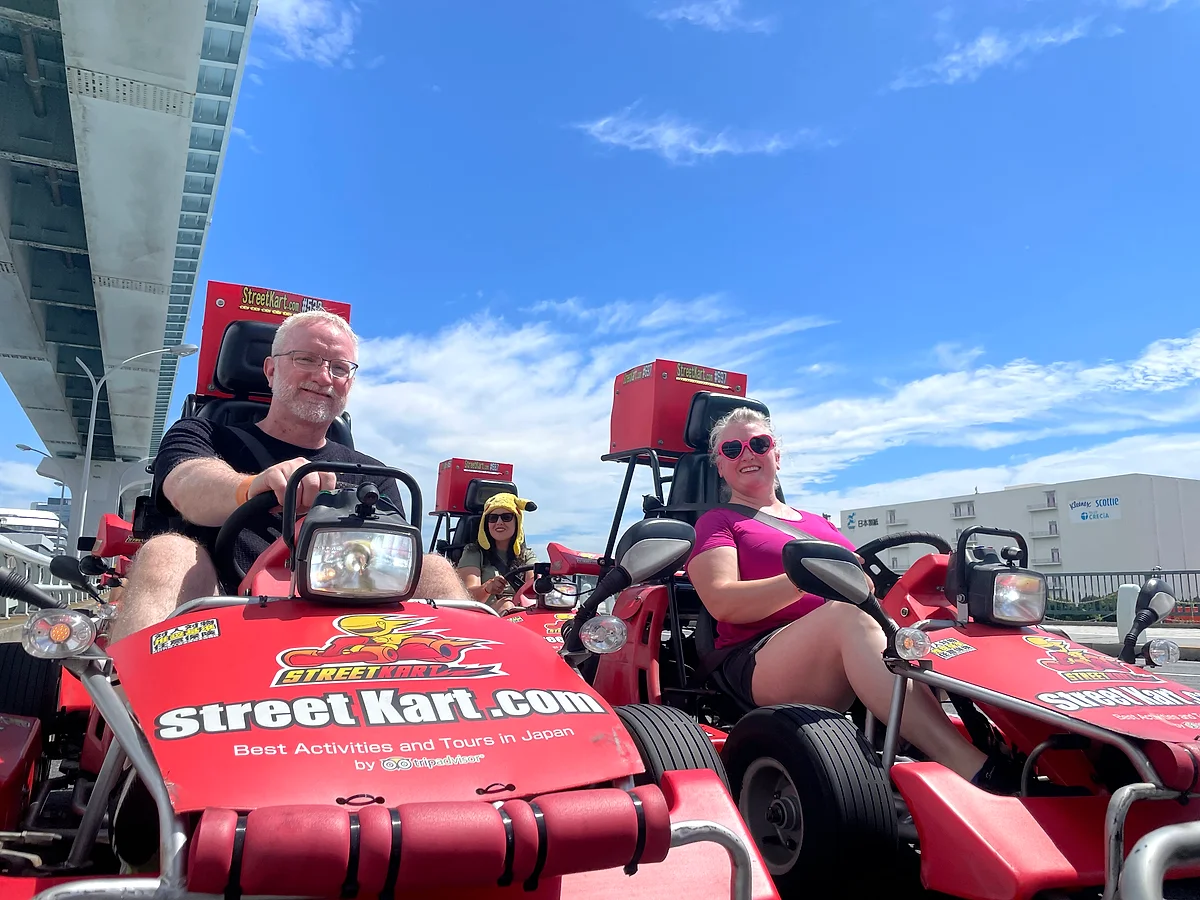
Once you're in the kart, your eye level drops dramatically. A bus tire you'd never normally look up at is right beside you. While you wait at a light, a breeze that's slipped between the buildings brushes past your neck. Sounds you never noticed while walking ring out right next to you. It's the same Tokyo, but just lowering your eye line one step makes the city feel like a different size.
Try counting the tour not in "how many minutes" but in "how many times the scenery changes." Your second Tokyo becomes a lot more interesting. The Shibuya shop's route materials list Scramble Crossing, Takeshita Street, and zelkova-lined Omotesando. The density of people, the height of the buildings, the green of the trees: that's where the breaks worth counting are.
The route materials for the Akihabara shops list the swarm of Electric Town signs, the red-brick Marunouchi building of Tokyo Station, and Ginza. From a city covered in signs to a station building that opened in 1914, then on to Ginza with its clock tower. It's as if eras are being turned over one page at a time, and it's genuinely moving.
The route materials for both Shinagawa and Tokyo Bay include Rainbow Bridge and Tokyo Tower. A 798-meter suspension bridge and a 333-meter red-and-white steel tower. The flow takes you from bayside warehouses and business districts into quintessential Tokyo views.
That said, the actual route is determined by the shop and course. When you book, check which views your course passes.
Don't miss the changes in light, either. Rainbow Bridge is lit up in seven colors at night. If you pick an evening slot, the bridge may look different at the start and end of your drive. But sunset times shift a lot with the seasons, especially if you're traveling in a different season from last time. Rather than assuming "it'll be dark by then," look up the sunset time for your travel date and line it up with your booking slot. If you're planning around changes in scenery, this is the single most effective bit of effort you can make.
Weather also moves the scene breaks. In light to moderate rain, tours go ahead as planned, and raincoats are provided. In heavy rain or typhoons, tours are canceled, and longer courses may be shortened. If your tour is shortened, check the end time with staff on the day. If you're traveling in a rainy season, it's easier on you to keep post-tour plans flexible in either direction. Check the official website for how cancellations and shortened tours are handled.
Scene Four: After the Tour, Until You're Back in the City
When you get out of the kart, your eye level returns to normal. From here, you can control your own time again.
But you don't go straight back into the city the moment you finish driving. The tour ends when you return to the shop and hand back the kart. The city scenery switches back to the shop interior one more time. Whether you can receive photo data depends on the service, so check when booking. If you can, include that time in this inside-the-shop scene too.
The trick here is not to be greedy. After driving, you'll be more pumped than you think. Looking back at your photos, saying "that part was great, wasn't it?" with the people you drove with, the time flies. Avoid scheduling anything with a fixed time right after the tour ends.
From here on, I'm talking not about the tour course but about places you can stop by near the shops. In Shinagawa, there's Shinagawa Shrine, about a 5-minute walk away, with a Fuji-zuka (miniature Mt. Fuji mound) on its grounds. It's a good place to let the afterglow of the drive settle quietly. If you can walk a bit farther, Tennozu Isle is about 20 minutes away on foot. With cafés and galleries along the canal, this time you can take in the waterside at walking pace.
In Akihabara, there's Kanda Myojin, about a 10-minute walk away. Stepping from the bustle of Electric Town into the shrine grounds, you can feel the air shift. In Shibuya, grabbing a bowl at Dogenzaka Ramen Yokocho, about 8 minutes on foot from the shop, is a solid option too. Time at the counter, face to face with your bowl. After a drive, it really hits the spot.
At Tokyo Bay, I recommend sitting down at CASICA at Shin-Kiba Station to sort through your photos. The blue of the sea and the orange of evening. Just a slight color adjustment can give a shot a lot more atmosphere. If you post, adding a place name like "Shinkiba" as a tag makes it easier to find again later yourself.
Looking at Street Kart's Appeal Through How You Spend Your Time
So far, I've written about how to estimate your time. Let me also sum up what Street Kart is actually about.
First, a guide leads the way. On every tour, a trained guide drives in front.
Second, the route is fixed. You could say there's no freedom. But because you know which stretch you'll be driving, it's easier to use as a reference when planning before and after. At the very least, it pairs well with the idea of dividing time by scenery.
Third, the Tokyo you see is completely different depending on the shop. Shibuya, the fashion district. A route where eras overlap as you go from Akihabara to Tokyo Station. The bayside seen from Shinagawa or Shin-Kiba. Just choosing a different shop from last time can make your second Tokyo look like a different city.
Fourth, the website is available in 22 languages. Note that on-the-day instructions are basically in English.
Fifth, its track record. As of November 2023, it had run over 150,000 tours, served over 1.34 million customers, and received over 20,000 reviews, with an average rating of 4.9 out of 5.0. These are all figures from that time, but they show that a lot of people have driven through these scenes.
Sixth, the scene breaks are clear. Tokyo on foot, Tokyo by kart, then Tokyo on foot again. A trip where your eye level switches twice in one day stays sharply divided into scenes even when you look back on it later. If you're putting together a short video, try making these transitions the highlights.
Before Booking, Decide the Order of Your Scenes
Finally, here's what to do before you book.
First, decide which shop's scenery you want to see. If you walked every corner of Shibuya last time, head for the bayside at Shinagawa or Shin-Kiba. If you've shopped in Ginza before, take the route from Akihabara through Tokyo Station to Ginza and see the same city from a new angle. There are combinations you can only choose because it's your second trip.
Next, look up the sunset time for your travel date and line up the light you want to see with your booking slot. Do you want the bayside in daylight, or Rainbow Bridge lit up? Once that's decided, your other plans will naturally fall into place around the before and after.
Weekends tend to fill up quickly, so once your dates are set, act early. You can find booking methods, contact details, course details, and the latest information on the Street Kart official website. If your itinerary might still change, check the cancellation and change policies too, so you won't panic when you need to rearrange the order of your scenes.
Step through the ticket gates. Open the shop door. Cruise through the city at a low eye level. Return to walking pace.
Try counting your Tokyo day not by the clock, but by the changes in scenery. You'll see a Tokyo that's different from last time.
This article was originally written in Japanese and translated using AI. Some expressions may read unnaturally, and we appreciate your understanding. For the most accurate and up-to-date information, please refer to the official site at kart.st.
Street Kart is not affiliated with Nintendo or the Mario Kart series in any way. We do not provide costumes of Nintendo characters, and such costumes may not be worn during tours even if brought by participants.